'It is by the grace of God that you find a diamond'
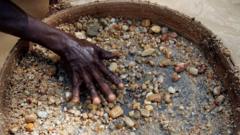
"It is by the grace of God that you find a diamond."
The surging demand for lab-grown diamonds has triggered a sharp decline in the value of mined stones, a shift that has forced the closure of Sierra Leone’s largest diamond mine. In Kono, the nation’s primary diamond-producing region, informal small-scale mining has become increasingly prevalent following the shutdown of Koidu Holdings last year.
At one such remote site, men work stripped to the waist under the intense sun, sifting and shoveling mud from a pit. Daniel, the foreman, demonstrates the process to a visitor, picking through gravel with his fingers. "We put it in water and we wash it," he explains. "If there is anything like a diamond or any bright stone, we can see it." Daniel and five other workers search for tiny fragments, but their returns are meager. "I have not made a lot of money yet," Daniel admits. "Sometimes for the whole of the year you can't get anything. 'It is by the grace of God that you find a diamond. We are just dreaming, really. We still have that hope."
The closure of Koidu Holdings resulted in the loss of 1,000 jobs after a contentious industrial dispute regarding worker pay. While the company officially cited the financial burden of the dispute and security issues as reasons for shutting down, insiders privately acknowledge that the broader weakness of the global market was also a factor. Over the last four years, the retail price of polished natural diamonds has dropped by approximately 40%. This decline is largely attributed to the rapid expansion of the lab-grown diamond sector. Produced in India and China using either high-pressure high-temperature (HPHT) or chemical vapor deposition (CVD) technologies, these factory-made stones are chemically and physically indistinguishable from mined diamonds but cost up to 70% less.
Augustine Shekho, the governor of Kono, notes that the dramatic drop in global natural diamond prices has severely impacted the region over the past five years. "Lower diamond values have reduced earnings for miners, constrained investment, and weakened local economic activity," he states.
Diamond mining has been the economic backbone of this part of West Africa since the 1930s. However, thirty-five years ago, the industry became the focal point of a brutal, protracted civil war in Sierra Leone, a conflict famously depicted in Leonardo DiCaprio’s 2006 film, Blood Diamonds. Kono was targeted due to its wealth of diamonds. Governor Shekho recounts multiple atrocities committed during the conflict, including the killing of his own mother, as armed factions vied for control. "They shot at random, they killed people, burnt the entire town," he recalls. "All houses were mined. 'It was a war of terror... She, my mother, unfortunately, was the victim of that… It was a nightmare. I would really not want to think about it."
The eleven-year conflict ultimately claimed more than 50,000 lives and left hundreds of thousands maimed or displaced. In 2003, the United Nations launched the Kimberley Process, an international certification scheme designed to prevent conflict diamonds from entering the mainstream market. Despite these efforts, the industry has struggled to overcome the associated reputational damage. "To me the diamonds have failed us," says Abubakar Amara, a primary school teacher in Kono. "What have those diamonds done for our community, for Kono, for Sierra Leone? We are considered as poor in the world."
De Beers, the British multinational specializing in diamond mining and marketing, is attempting to alter this narrative. In Sierra Leone, the company has introduced Gemfair, a project that provides local artisanal miners with equipment, training, and more transparent pricing for their discoveries. Often described as a fairtrade scheme for diamonds, the initiative aims to improve market access. "The idea is to connect with markets so that they can be able to find a place to sell their diamonds, and also to empower them, give them training, we give them skills," says Raymond Alpha, Gemfair’s local representative.
Source: BBC News Generated at: 2026-06-03 23:00:45 UTC